
Main Points
- When the compressor fails, refrigerant stops circulating, and your air conditioner can’t remove heat from your home.
- A failed compressor can’t be repaired and forces many homeowners to choose between replacing the component or upgrading their entire system.
- If you suspect compressor failure, immediately shut off your system and call Thermo Direct for a professional diagnosis.
When your AC compressor fails, your air conditioner can’t cool your home. The indoor blower often keeps working, which is why you might still feel air coming from your vents, but that air is often room temperature and won’t keep you cool.
Below, we’ll explain what happens during AC compressor failure, and how it often leads to a decision between replacing the component or the entire system.
What Does the Compressor Do in Your Air Conditioner?
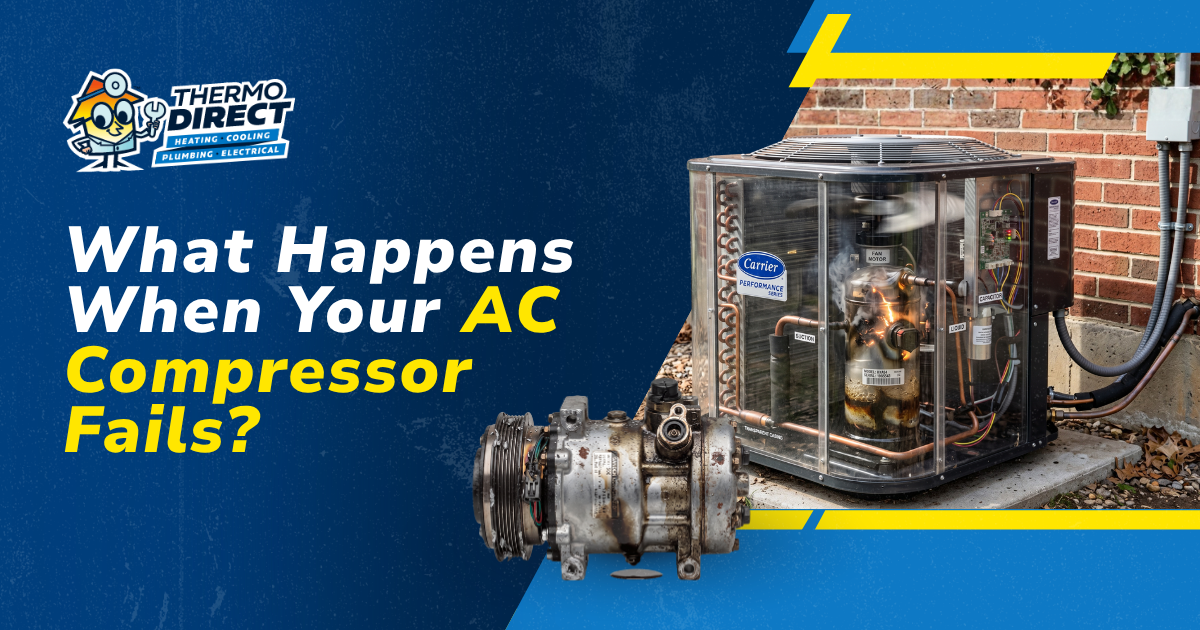
The compressor is responsible for moving heat out of your home and releasing it outside. It takes low-pressure refrigerant vapor that comes back from your indoor coil and compresses it into a high-pressure, high-temperature state. It then sends that pressurized refrigerant to the outdoor coil, where heat is collected and released outdoors. The refrigerant then cools, expands, and returns indoors to repeat the process.
What Happens After the Compressor Stops Working?
When your AC compressor fails, the refrigerant cycle stops. Because there’s nothing moving it, refrigerant stays in lines instead of circulating, so your indoor coil never gets cold and no heat leaves your home.
Notice your AC running but not cooling? Your thermostat will often still read a temperature above its setpoint, causing it to keep calling for cooling. The indoor blower responds and keeps pushing air through your ducts, but the house keeps getting warmer.
What Are the Warning Signs of a Failing Compressor?
Understanding the warning signs of a bad AC compressor can help you catch the issue before it turns into a costly replacement.
The AC runs but does not cool
When the compressor fails, your AC will continue to run without actually cooling your home. The outdoor fan may keep spinning, and the thermostat will call for cooling, but indoor temperatures will continue to climb all afternoon.
Warm air comes from the vents
If the air coming through your vents suddenly feels room temperature, it’s a clear sign that the refrigeration cycle has stopped. When your AC is working properly, the air coming from your vents should always feel noticeably cooler than the room around you.
The outdoor unit makes humming, grinding, or rattling noises
Notice your AC compressor making noise? When the compressor tries to turn on and can’t, it often produces a grinding or rattling noise during startup.
The system struggles to start
A straining noise or stutter as your system tries to start can point to an AC compressor that’s not working. Compressors draw a significant electrical load at startup, which becomes even harder when something’s wrong.
The breaker trips repeatedly
A failing compressor draws more current than it should, which can trip the breaker that protects it. If your AC compressor is tripping the breaker, it’s a sign that your system needs a technician rather than a reset.
Cooling cycles become longer or less effective
Before the compressor fails, it can move refrigerant through your system at a reduced rate. Your AC will run for longer than it used to and never quite reach the temperature set on your thermostat.
The outdoor unit starts and stops unexpectedly
Your outdoor unit continuously starting and stopping is a sign that the internal overload protector is cutting power to prevent overheating. You’ll often notice short bursts of operation followed by silence, repeating throughout the day.
Does Every Cooling Problem Mean the Compressor Is Bad?
Not every cooling problem is related to the compressor. Other causes include a failing capacitor, low refrigerant levels, a bad outdoor fan motor, a thermostat malfunction, or a frozen evaporator coil. Many of these problems are straightforward repairs that cost a fraction of compressor replacement.
Why Do Air Conditioner Compressors Fail?
Most compressor failures are caused by an underlying issue that’s gone unaddressed. Common culprits in Raleigh homes include:
- Low refrigerant from an untreated leak.
- Restricted airflow from a clogged filter.
- Electrical issues causing repeated hard starts.
- Short cycling adding wear with every restart.
- A compressor that’s past its 12- to 15-year lifespan.
What Can You Safely Check Before Calling a Technician?
Before you call in a professional, there are a few things you can safely check to narrow down the problem:
- Check that the thermostat is set to cool.
- Feel whether the air coming from your vents is cold, cool, or warm.
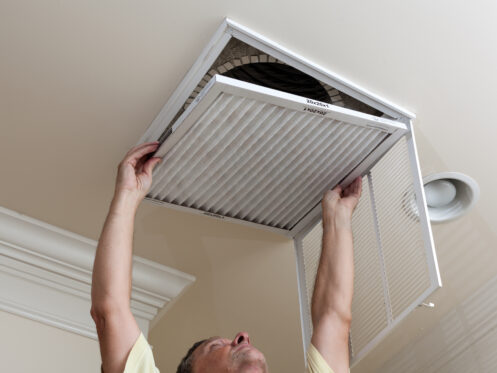
- Inspect the air filter for clogs and replace it if necessary.
- Listen for running, humming, or grinding noises.
Should You Keep Running the AC?
If you suspect the compressor is failing, immediately turn off your air conditioner at the thermostat. Continuing to run your AC can make the damage worse and turn a repairable issue into a complete system failure.
Can a Failed Compressor Be Repaired?
Compressors always require replacement when they fail. Because they’re sealed units, it’s not possible to open them up and repair their internal parts.
Thankfully, some problems that mimic failing AC compressor symptoms are actually quick fixes. Dead capacitors, burned contactors, or failing start relays can prevent your compressor from starting up, and won’t run you nearly as much as compressor replacement.
Do You Replace the Compressor or the Entire AC System?
Deciding whether to replace the compressor or your entire AC unit depends on its warranty status, age, refrigerant type, and repair history. If the compressor is over 10 years old, in an aging system, circulating phased-out refrigerants, or on its third repair, AC replacement is often a better investment.
Why Compressor Problems Become Serious During Raleigh Summers
Triangle summers come with high humidity and temperatures that extend run times and keep your compressor working with fewer chances to cool down between cycles. That added workload can push a worn-out compressor to its limit and result in a complete failure, causing indoor temperatures to quickly rise and put your entire household at risk.
How Thermo Direct Can Help After a Major AC Failure
At Thermo Direct, we handle major AC failures fast. Our licensed and insured technicians quickly identify the root cause of your cooling issues, walk you through your repair and replacement options, and help you find the right solution for your household.
Call us or book online to schedule your AC repair in Raleigh today! We provide same-day and emergency services for no-cool emergencies and offer flexible financing options for major repairs or replacements.
Frequently Asked Questions
How long does compressor replacement take?
We complete most compressor replacements in a single day. If your system requires a specialized compressor, we may need more time to source the part.
Can professional AC maintenance prevent compressor failure?
Routine maintenance reduces the odds of compressor failure by catching hidden issues early. Technicians locate and repair refrigerant leaks, dirty coils, and weak start components early on, before they affect the compressor.
How can I tell whether the compressor or capacitor has failed?
A dead compressor and failing capacitor often produce the same symptoms. Telling them apart requires electrical testing by a licensed professional.