

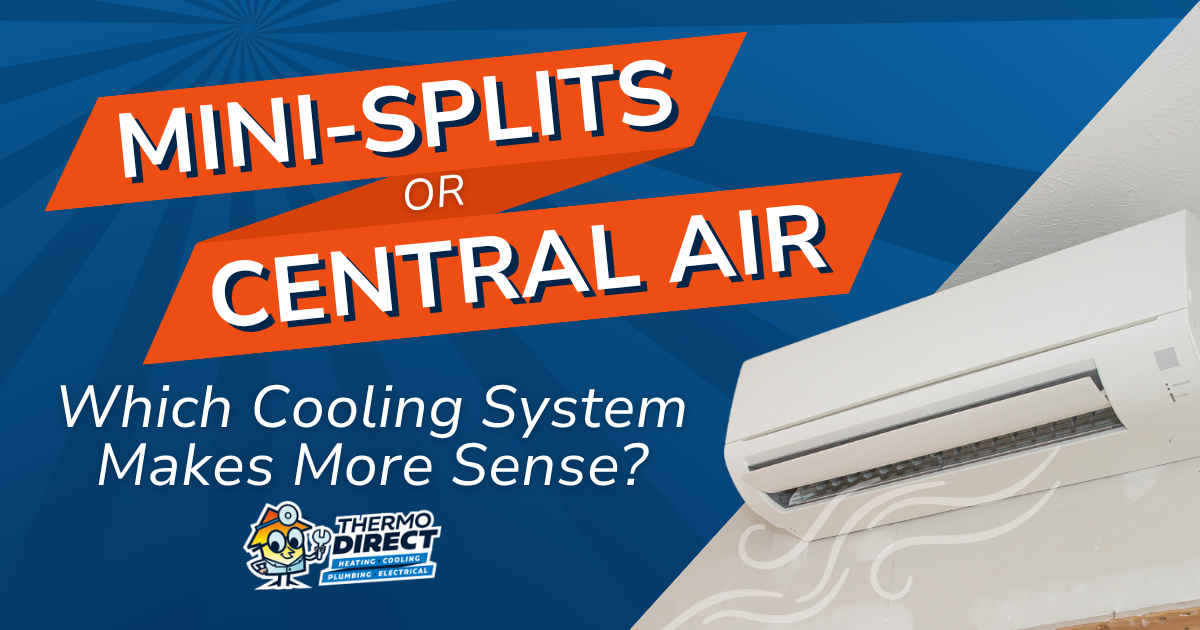
Quick Recap
- Mini split vs central air — the best choice of cooling system for your home depends on layout, ductwork, and which rooms need cooling.
- Both systems can work well in Raleigh homes, they just solve different problems.
- A ductless mini split vs central air comparison usually comes down to zoning flexibility and the ductwork you already have.
- The best cooling system for your home is the one that fits how your house is built and how you live in it.
Two types of systems dominate home cooling. Central air is often the best choice when you have existing ductwork and you want to cool your whole house. Mini-splits shine when you don’t have ductwork, or when you have rooms that just always feel too hot or too cold.
The mini split vs central air question comes up a lot in the Raleigh area, because of our hot and humid summer months, and where different home types across the Triangle can all present challenges — like uneven airflow, limited ductwork, or inefficient ducts.
What’s the Difference Between Mini-Splits and Central Air?
The core difference between mini-splits and central air is how each system delivers cooled air. A ductless mini split sends air directly into a room through a wall, ceiling, or floor unit — no ductwork required. Central air cools from one central unit and distributes it through the ductwork in your home.
But even if you have ductwork installed in your home, its efficiency can play a big role in deciding the best cooling system for your home. The U.S. Department of Energy notes that duct losses can account for more than 20% of AC energy use in some homes — which is why mini splits often outperform systems with leaky ducts.
When a Mini-Split Makes More Sense
A mini-split is the right call when you need targeted cooling without depending on ductwork. Often, converted attics, garage apartments, sunrooms, home additions, or bedrooms stay stuffy no matter how long the central AC runs.
If you’re exploring mini-split installation in Raleigh, you’re likely trying to solve a specific comfort problem like a hot upstairs bedroom or finished attic — or maybe you’re in an older home that was never designed for full ductwork. For these situations, the most energy-efficient answer to which is better, mini split or central air, is often the mini-split.
When Central Air Makes More Sense
Central air makes sense when you need consistent whole-home cooling through one integrated system. If your home already has ductwork in good condition, it’s often the cleanest and most straightforward solution.
If you’re planning AC installation in Raleigh, central air is the first thing to evaluate. In a mini split vs central air decision, central air usually wins when your goal is broad, uniform coverage rather than targeted zones. But other factors, such as variable speed vs single stage, also play a role.
Is It Time to Replace Your AC?
If your current system is aging, unreliable, or facing a major repair, replacing it may offer better comfort and long-term value.
Pros and Cons of Central Air
Central air in Raleigh is simple and consistent, especially when ductwork already exists.
Pros of central air:
- Even, whole-home cooling from a single thermostat
- Hidden system (vents in walls and ceilings)
- Straightforward operation and familiar setup
- Lower upfront cost if ducts are already in place
Cons of central air:
- Energy loss through ductwork
- Limited room-by-room control
- Can create uneven temperatures if airflow isn’t balanced
What Affects Cost When Comparing Mini-Splits and Central Air?
Cost depends on three things: existing ductwork, how many rooms you need to cool, and whether electrical upgrades are required. A single-zone mini-split can be cheaper than installing new ductwork. But for full-home coverage, a multi-zone system can cost more than central air.
Proper sizing also plays a role in both cost and performance — see Thermo Direct’s guide to choosing the right AC size. And remember, over time, energy efficiency can offset higher upfront costs, depending on how the system is used.
Which Cooling System Is More Energy Efficient?
Are mini-splits or central air systems more energy efficient? Mini-splits skip ductwork and allow room-by-room control. ENERGY STAR notes that high-efficiency ductless (mini split) systems can reduce energy use in the right applications.
That said, high-efficiency central air performs well when ducts are properly sealed, the system is correctly sized, and the goal is whole-house cooling.
How to Decide Which One Is Right for Your Home
The best cooling system for your home is the one that solves your home comfort issue. That’s why it’s best to start with evaluating your home and not the system. Ask: Are your ducts in good condition? Is your goal to cool the whole house or just one problem area? Do you want zoning control or one thermostat? These will help find the honest answer to which is better, mini split or central air?
Why This Decision Matters in Raleigh Area Homes
Housing stock, humidity, and layouts vary across the Triangle. A newer home with solid ductwork is a very different situation from an older Raleigh bungalow with a finished attic addition. And with long, humid summers, an underperforming system becomes inefficient and costly — fast. NOAA climate data for Raleigh shows how hard cooling systems work here in the summer.
That’s why mini-splits or central air isn’t just a technical question in the Raleigh-Durham area — it’s a comfort, efficiency, and installation question.
How Thermo Direct Can Help
When you’re weighing mini split vs central air, expert guidance matters. We’ll evaluate your home’s ductwork, its layout, and hot spots. If central air makes sense, we’ll guide you through replacement and sizing. If a mini-split is the better answer, we’ll recommend the right zones and placement. For more info about how Thermo Direct can help, see our cooling services and check our current savings.
Choose the Cooling System That Fits Your Home Best
For a hot room, an addition, or an older home without ducts, a mini-split is often the smarter move. For a full house with solid ductwork that needs even cooling, central air may be the better choice. But whatever situation you’ve got, when you’re ready for an AC solution that’s right for you, contact us.
Frequently Asked Questions
Is a mini-split better than central air?
It depends on what you need. A mini-split is the better choice when you’re looking for targeted cooling, zoning flexibility, or a solution for a space without ductwork. Central air is usually a better fit for whole-home cooling.
What’s the difference between a mini-split and central air?
A ductless mini-split delivers conditioned air directly into a room without ducts. Central air cools air at a central unit and moves it through your home via its ductwork.
Are mini-splits more energy efficient than central air?
Yes, mini-splits are often more energy efficient because they eliminate duct losses and let you cool only the rooms you’re using. Central air performs well when ducts are in good condition and the system is properly sized.
Is central air better for cooling an entire house?
Yes, central air is generally better for cooling an entire house when ductwork is already in place and in good condition.
Do mini-splits work well in older homes without ductwork?
Yes — mini-splits are often an excellent fit for older homes without ductwork because they avoid the cost of adding ducts.
When should I talk to an HVAC professional about choosing between mini-splits and central air?
Talk to a professional when you’re weighing a full cooling system replacement against a more targeted solution, dealing with uneven comfort in your home, or want accurate pricing on mini-split or central air installation.