
Expert Insights
- The AC expansion valve regulates refrigerant and supports optimum cooling performance.
- It’s important to recognize the signs that your AC expansion valve is going bad to make the necessary repairs.
- Thermo Direct Heating, Cooling, Plumbing, and Electrical provides reliable, professional AC repairs in Raleigh, including expansion valve replacement.
You’ve just turned on your air conditioner, and the system starts running, but your home remains warm. Why is your AC not cooling? During North Carolina’s hot summers, an AC that isn’t cooling is a frustrating but common issue that could be due to an expansion valve problem or something else. It’s important to know what is going on so you can get your home comfortable again. Learn the most common causes of an AC that doesn’t cool properly and when to schedule AC repair with Thermo Direct.
What Does an AC Expansion Valve Do?
When you return home from the North Carolina Museum of Art, the last thing you want to face is a non-working air conditioner. AC problems may be due to several things, including an issue with the AC expansion valve, a component that regulates refrigerant pressure. If you live in Raleigh, NC, Thermo Direct Heating, Cooling, Plumbing, and Electrical experts are available to help with all of your AC repair needs. Here, we’ll review some common bad AC expansion valve symptoms to help you identify this issue.
Role of the expansion valve in your cooling system
The expansion valve reduces refrigerant pressure as it moves from the condenser to the evaporator, allowing it to expand, vaporize, and absorb heat. It also controls refrigerant flow to optimize cooling performance.
What happens when the valve fails
If the expansion valve fails, your AC may blow warm air, struggle to cool your home, or even suffer compressor damage.
What Are the Signs of a Bad AC Expansion Valve?
These signs may help you learn how to tell if the AC expansion valve is bad: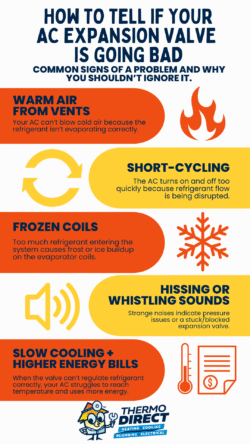
- Is your AC blowing warm air? If your AC is not blowing cold air, a stuck or partially closed expansion valve may prevent refrigerant from evaporating properly, causing warm air to blow from the vents.
- Does your AC cycle on and off frequently? A faulty expansion valve can cause short-cycling by disrupting refrigerant flow, making the unit turn on and off too often or run too long without cooling.
- Are your coils freezing or covered in frost? A malfunctioning valve may allow too much refrigerant into the system, leading to frozen or frosted evaporator coils.
- Is your AC making hissing or unusual noises? Hissing, whistling, or gurgling sounds may indicate refrigerant flow issues caused by a stuck or blocked expansion valve.
- Does your AC take too long to cool your home? When the valve can’t regulate refrigerant properly, your system’s cooling performance drops, causing delays in reaching the desired temperature.
- Can a bad valve trigger high energy bills? Yes—your system works harder when refrigerant isn’t managed efficiently, driving up your energy costs.
How to Diagnose Expansion Valve Issues
Here are some tips for how to diagnose expansion valve issues and what to know when you schedule an AC diagnosis in Raleigh.
Can homeowners spot the warning signs?
While these warning signs might not be due to a bad expansion valve, they could indicate that the valve needs to be replaced:
- Your AC blows warm air or takes too long to cool your home.
- A strange hissing, whining, or gurgling sound is coming from your AC.
- The evaporator coils are frozen or covered in frost.
- The air conditioner is short-cycling and won’t stay on or off for an extended period.
What tools do HVAC technicians use to diagnose valve problems?
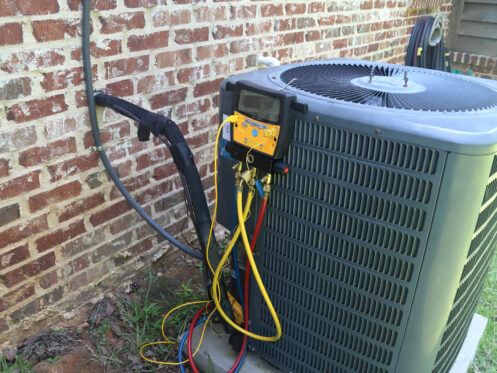
The HVAC technician in Raleigh, NC, may use one or several tools to detect refrigerant leaks and diagnose expansion valve problems, including:
- Manifold gauge set
- Refrigerant leak detector
- Multimeter
- Valve core replacement tool
Can a Bad Expansion Valve Stop Your AC From Cooling?
Yes, a bad expansion valve can stop your AC from cooling properly. The expansion valve reduces refrigerant pressure as it moves from the condenser to the evaporator, allowing it to expand, vaporize, and absorb heat. It also controls refrigerant flow to optimize cooling performance.
If the expansion valve fails, your AC may blow warm air, struggle to cool your home, or even suffer compressor damage.
Is It a Bad Expansion Valve or Another AC Problem?
Understanding how expansion valve symptoms compare to other common AC problems can save you time and help you have a more informed conversation with your HVAC technician.
Bad expansion valve
A bad expansion valve typically causes inconsistent or insufficient cooling. Your system runs, but it can’t properly regulate cooling refrigerant flow into the evaporator coil. You may notice:
- Air coming from the vents isn’t as cold as it should be.
- Your system runs continuously without reaching your desired temperature.
- The evaporator coil has frozen.
Refrigerant leaks
Refrigerant leaks can give off warning signs similar to a bad expansion valve, such as reduced cooling, failure to reach the desired temperature, and frozen coils. However, the key difference is the amount of liquid. Even a small refrigerant leak can leave your refrigerant levels too low for optimal cooling.
Dirty air filters
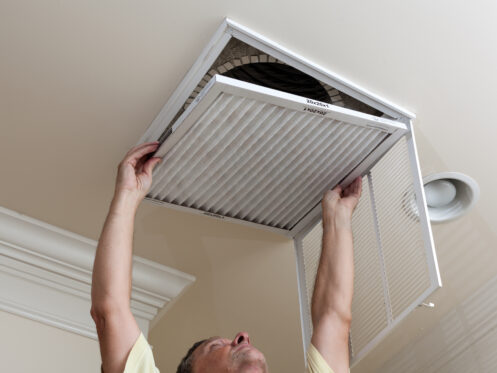
Dirty air filters restrict airflow so that even a perfectly functional refrigerant circuit won’t transfer heat effectively. This is one of the most common reasons for reduced cooling and one of the easiest DIY checks. If you hold up your filter to the light and can’t see through it, or if it looks gray and clogged, it’s likely time for a replacement.
A failing capacitor or compressor
If your system is struggling to start, making unusual and loud noises (banging, grinding, hissing), or shuts off at random, it could be due to a failing capacitor or compressor.
| Potential AC Issue | Warning Signs & Contextual Symptoms | Diagnostic Focus |
|---|---|---|
| Bad Expansion Valve Refrigerant Circuit |
|
The system runs, but it cannot properly regulate the cooling refrigerant flow directly into the evaporator coil. |
| Refrigerant Leaks Charge Deficit |
|
The key operational difference is the amount of liquid; even a tiny leak leaves refrigerant levels too low for optimal cooling. |
| Dirty Air Filters Airflow Blockage |
|
This issue restricts airflow so that even a perfectly functional refrigerant circuit won’t transfer heat effectively. One of the easiest DIY checks. |
| Failing Capacitor or Compressor Mechanical / Electrical |
|
Indicates a critical mechanical breakdown or electrical delivery fault. Requires immediate professional intervention to prevent permanent equipment destruction. |
Low Refrigerant vs. Bad Expansion Valve: How Are They Different?
Low refrigerant and bad expansion valves have many of the same symptoms, and in some cases, one issue can contribute to another. Below is the best way to think about the difference.
Low refrigerant
Low refrigerant means your system is operating with less refrigerant than it was designed to use. Refrigerants don’t get used up like car fuel. If your levels are low, there’s likely a leak somewhere in the system. Signs of low refrigerant include:
- Warm air from vents.
- Hissing or bubbling sounds by the refrigeration line.
- Ice forming around lines.
To repair a refrigerant leak, our professional HVAC technicians will find the leak, seal it, and recharge the AC with a proper refrigerant level top-up.
Faulty expansion valve
A bad expansion valve means the component that controls how much refrigerant enters the evaporator coil is malfunctioning. If the valve is stuck closed or damaged, it restricts refrigerant flow, preventing it from reaching the evaporator.
The difference between a low refrigerant issue is the repair job needed. Usually, the valve needs to be replaced.
Can You Repair a Bad Expansion Valve?
You may wonder whether you can repair a bad expansion valve or whether it should be replaced. In some cases, the valve may be repaired, especially if it’s just stuck in one position or if the core is worn out. However, it’s typically best to replace the entire valve to prevent problems from recurring in the future. Replacing the valve provides a much better long-term solution than a repair, which doesn’t guarantee that it won’t break or malfunction later.
Why Expansion Valve Issues Shouldn’t Be Ignored
Calling an AC not blowing cold air repair service in Raleigh is advised if you suspect a bad AC expansion valve. Here’s why this issue should not be ignored:
- Damage to the compressor or the entire AC unit: A faulty expansion valve can disrupt refrigerant flow, damaging the compressor and potentially leading to total system failure if left unaddressed.
- Reduced cooling efficiency and shortened lifespan: A malfunctioning valve forces the AC to work harder, reducing cooling efficiency and accelerating wear on components, which may lead to early system replacement.
- Preventing more costly emergency repairs: Catching and fixing a bad expansion valve early can help you avoid expensive repairs and keep your AC running reliably during peak summer heat.
What You Can Check Before Scheduling AC Repair
Before you call a technician, there are several things you can check yourself that may resolve the issue:
- Air filter: We recommend replacing your air filters every one to three months. If yours is clogged, replacing it could resolve the issue.
- Thermostat settings: Set the system to “cool” and not “fan only.” Also, check that the temperature is set below the current room temperature and that the thermostat is functioning correctly. If it’s not, replace the batteries.
- Circuit breaker: A tripped breaker can cause the outdoor unit to shut off while the indoor air handler continues to run, circulating uncooled air.
- Outdoor unit: Make sure nothing is blocking your unit’s airflow, like plants, debris, fencing, or storage items too close to the unit. The condenser needs clear space on all sides to work properly.
Call Thermo Direct for Your AC Cooling Issues
Thermo Direct Heating, Cooling, Plumbing, and Electrical is a family-owned, licensed, and insured HVAC company serving Raleigh homeowners for over 20 years. Same-day AC diagnostics and repairs are available, and we offer flexible financing options to help you pay for an AC replacement. We’re backed by 5-star customer reviews and service satisfaction guarantees. If you’d like to schedule service to fix an AC that’s not cooling your home, contact us today!
Frequently Asked Questions
How does an expansion valve affect AC performance?
An expansion valve regulates the pressure of AC refrigerant throughout the system. If it’s broken or stuck, it may affect AC performance by causing short-cycling, blowing warm air, reducing energy efficiency, and reducing indoor comfort.
What happens if the AC expansion valve is stuck open or closed?
If the AC expansion valve is stuck open, the system receives too much refrigerant, which freezes the evaporator coils and reduces efficiency. If the valve is stuck closed, the system won’t receive any refrigerant, causing the AC to stop blowing cool air and damaging the compressor.
Will a failing expansion valve cause my AC to freeze up?
Yes, if the expansion valve is failing, it may cause your AC unit to freeze up. Too much or too little refrigerant can cause compressor issues, short-cycling, and even the entire system to stop working altogether.
Why is my AC running but not cooling my house?
Your AC running but not cooling the house could point to several problems, such as low refrigerant, a faulty expansion valve, or a failing compressor. Give Thermo Direct a call to diagnose and fix the issue.
Can a bad expansion valve cause my AC to freeze?
Yes, a bad expansion valve can cause your AC to freeze. If the valve is stuck closed, refrigerant flow to the evaporator coil is restricted, which causes the coil temperature to drop below freezing. If the valve is stuck open, the evaporator floods with refrigerant, causing freezing.
Is it safe to keep running my AC if the coils are frozen?
No, it’s not safe to run an AC if the coils are frozen. Operating the system with frozen coils forces refrigerant back into the compressor, which can cause severe damage.
How long does it take to replace an AC expansion valve?
It usually takes a few hours to replace an AC expansion valve. During the service job, Thermo Direct will also test the AC system to make sure everything is working properly.
Should I repair the expansion valve or replace the AC system?
You can usually repair a faulty expansion valve rather than replacing the entire AC system. However, if your faulty expansion valve has caused additional damage over time, especially in an older system, you may want to consider replacement.