
Key Findings
- Leaving the porch light on overnight does not offer major security benefits.
- Smart lighting and motion sensor lighting are better options for deterring burglars.
- LED bulbs help save energy for your home security lighting.
The Porch Light Question Most Homeowners Ask
As a homeowner, you’ve probably wondered if keeping the porch lights on at night is a good idea for your home’s security or just something that wastes power. For the most part, it’s one of those old North American myths — that leaving on your porch lights will deter burglars. In reality, leaving porch lights on consumes significant energy and may compromise your home’s security. Thermo Direct has created this handy guide to shed some light on this nighttime dilemma.
Should You Leave Your Porch Light on at Night?
While you should leave your porch light on at night if you’re expecting visitors or deliveries, it’s not typically recommended to leave your porch light on every night. Leaving the porch light on offers minimal security protection and also uses up a lot of energy, so the cons largely outweigh the benefits.
| ✔ When it helps | ✖ When it hurts |
|---|---|
| ✔Helps guests & family navigate safely at night | ✖Creates predictable patterns burglars can exploit |
| ✔Useful for expected nighttime deliveries | ✖Can signal the home is unoccupied when always on |
| ✔Illuminates walkways to reduce trip hazards | ✖Higher energy use vs. motion or smart options |
| ✔Makes house number visible to delivery drivers | ✖Little evidence it deters crime on its own |
When Keeping Your Porch Light on Helps
While leaving the porch light on at night doesn’t really prevent crime, it can still be helpful in other ways. Beyond home security, leaving porch lights on at night helps family members navigate the front of the house, reducing the risks of falls or slips on uneven pavement or walkways. Furthermore, they can be helpful if you are expecting a nighttime delivery.
When Leaving Your Porch Light on All Night May Not Be the Best Idea
Leaving the lights on can signal to potential burglars that you’re not home, so it can actually do more harm than good for your home security. Potential burglars typically search for patterns when scoping out a house, so if you routinely leave your porch light on while you’re away, it can become an opportunity for theft.
Always On vs. Motion Sensor vs. Smart Timer: Which Is Better?
Between leaving the porch light on vs. motion-sensor lighting vs. Smart Timer lighting, leaving the porch light on is the least effective option for security and energy. Leaving it on continuously can create predictable patterns and use up a lot of energy, leading to higher utility costs.
Smart Timer lights are much more energy-efficient, as they follow a schedule that fits your lifestyle. For example, you can set your lights to turn on just before you arrive home from work or at different intervals while you’re away on vacation. While this can still become predictable, it’s a much better security option than just leaving the porch light on.
For security options, motion sensor lighting typically takes first place. Since these lights react to movement, they don’t risk becoming predictable to potential burglars. Additionally, motion lights turning on suddenly can also startle potential burglars and further discourage theft. Motion sensor lighting also offers the convenience of turning on when you or your guests arrive home, creating a safer, more comfortable walkway. Since they only turn on as-needed, they’re also a good option for saving energy.
How Much Does It Cost to Leave a Porch Light on Overnight?
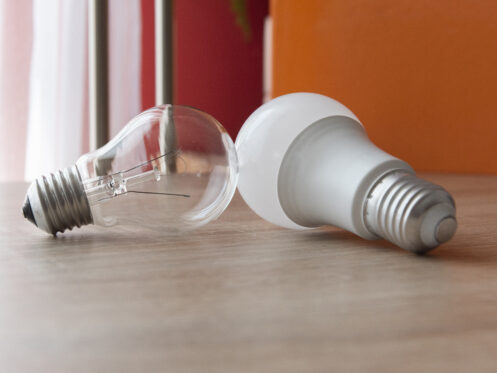
In the Raleigh area, leaving a porch light on overnight, every night, typically costs around $20.57 per year. However, the type of bulb also matters: a 60-watt incandescent bulb running 12 hours per night costs roughly $42 per year for a single bulb, while a comparable LED bulb costs $6 per year and is a better option for saving money on your electric bill.
Does Leaving a Porch Light on Deter Burglars?
While it’s often believed that leaving a porch light on can help deter burglars, there’s little support for this. In fact, leaving a porch light on with a regular schedule can actually pose a security risk for your home, since potential burglars can start to predict patterns for when you’re home, away, or asleep. Rather than leaving a porch light on overnight, it’s recommended to choose lighting systems like Smart lighting or motion sensor lighting that operate on a more unpredictable schedule to deter theft.
Is a Motion Sensor Porch Light Better?
Yes, motion-sensor lighting is typically considered one of the best options for deterring burglars. In addition to startling potential burglars if they come close to your home, motion-sensor lighting removes the predictability from your home’s lighting schedule. This makes it harder for potential burglars to figure out when you might be away from home.
Smart Porch Lights, Timers, and Dusk-to-Dawn Lights
Smart porch lights, timers, and dusk-to-dawn lights all offer advantages over just leaving the porch light on overnight. Smart lights offer the most customization, as they can integrate with a wide variety of home security products like Ring, Google Home, and Lutron. You can also connect your Smart lights to apps so you can check on your home and control the lighting even when you’re away.
While lighting timers and dusk-to-dawn lights don’t offer quite as much flexibility or security, they’re still a good way to save energy compared to traditional porch lights. You can set timers to come on while you’re away or when you return home from work, or simply use them while you’re on vacation to give the impression that someone is at home.
Dusk-to-dawn lights automatically sense light levels and turn on when the sun sets, then turn off when it rises. While this is a predictable schedule that doesn’t add much to home security, it’s more energy-efficient than leaving the porch light on all night.
What Color Porch Light Is Best at Night?
For security purposes, bright white LED lights provide the best visibility. However, if bugs are a concern, warm white or yellow LED bulbs are less attractive to insects because they emit less ultraviolet light and produce less heat than traditional bulbs.
Safe Homeowner Checks Before Upgrading Your Porch Light
If you’re thinking about upgrading your porch light, or if you’re simply planning to swap out your lightbulbs, remember to follow these outdoor lighting safety checks before you start:
- Turn off the power at the main breaker before you touch any lighting fixtures.
- Use a non-contact voltage tester to confirm that power to the fixture is off.
- Confirm that all switches and fixtures are properly grounded.
- Check that any new fixtures or bulbs you’re planning to use have the appropriate outdoor weather rating.
While swapping out a lightbulb is typically quick, easy, and safe with proper precautions, more advanced outdoor lighting upgrades often require professional electrical installation. When upgrading to a security lighting system with multiple fixtures, motion sensors, timers, or smart home integration, professional installation guarantees everything works together reliably.
Warning Signs You Should Call an Electrician
Beyond calling a pro for outdoor lighting installation in Raleigh, there are several common signs that you may need to call an electrician: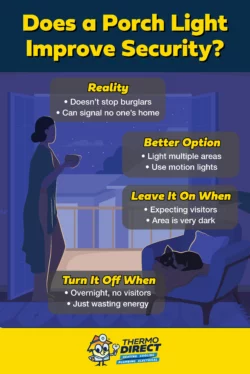
- Burning smells
- Smoke
- Circuit breaker tripping repeatedly
- Buzzing or sizzling noises
- Sparks
- Visible scorch marks or discoloration
- Water inside the light fixture
These can all indicate a serious electrical issue with your porch light or fixture. If you notice any of the issues, turn off the light and contact a local electrician for a professional electrical inspection.
Why Outdoor Lighting Matters for Raleigh and Durham Homeowners
Exterior house lights are a great way to improve the security, safety, and comfort of your Raleigh or Durham home. The right outdoor lighting can help deter potential intruders, boosting your home’s security. It can also make your walkway safer for your family and guests, and make it easier for delivery drivers to find your home.
Porch Light Safety and Security Checklist
Make sure your front porch lighting is operating properly with these easy checks:
- Test motion sensor lights once a month to make sure they’re triggering properly.
- Replace any burnt-out or dimmer bulbs promptly.
- Make sure key parts of your home are illuminated, including walkways, any entrance points, the driveway, and the house number.
- Check that any adjustable lights face downwards to illuminate the area without blinding drivers.
How Thermo Direct Can Help With Outdoor Lighting
If you’re looking to upgrade your home’s outdoor security, switching to motion-activated lighting or Smart bulbs may be a good investment to enhance security and energy efficiency. At Thermo Direct, Raleigh homeowners count on us for comprehensive electrical services, ranging from electrical repairs to security installations. Call us today to find the proper outdoor lighting setup and keep your home safe.
Frequently Asked Questions
Do porch lights attract bugs?
Yes, porch lights do attract some bugs. You can minimize this by choosing warm or yellow LED bulbs, which are less attractive to insects.
Should I leave my porch light on while I am on vacation?
No, it’s not recommended to leave your porch light on while you’re away. A light that’s always on typically signals to burglars that the home is not occupied, which can make it a target. Instead, choose timers, Smart lighting, or motion sensor lights for a more unpredictable pattern.
Can outdoor lights make my home safer?
Yes, the right outdoor lighting can help make your home safer. The best options for deterring burglars are motion-sensor and Smart lights, as they don’t create predictable patterns. Standard outdoor lighting can also improve home safety by illuminating areas like your walkway and driveway so you can walk safely in the dark.